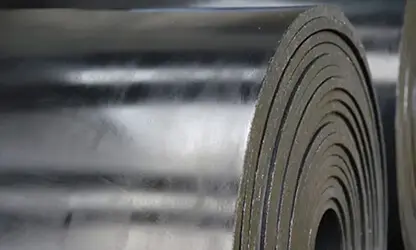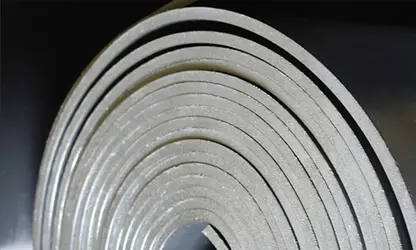
Nitrile Rubber (NBR)
Nitrile rubber with excellent oil and fuel resistance for industrial gaskets.
Explore RubberThe high-performance HNBR you need for seals, gaskets, and components in automotive, heavy machinery, and oil & gas. Superior resistance to oils, greases, ozone, and extreme temperatures. 70-75 Shore A. Get a quote in 24 hrs!
Looking for a material that withstands extreme conditions where other elastomers fail? Hydrogenated nitrile rubber (HNBR) is the solution you need. This high-performance elastomer, obtained through hydrogenation of conventional nitrile, offers superior heat resistance, ozone resistance, and chemical resistance, far surpassing NBR in demanding applications.
With a Shore A hardness of 70-75 and an extended temperature range of -60°C to +160°C, HNBR is ideal for seals, gaskets, O-rings, and components in automotive applications, heavy machinery, and oil & gas. Its oil and grease resistance at high temperatures makes it the preferred choice for applications where reliability is critical.
At Everest Group, we offer hydrogenated nitrile rubber in rolls and sheets with ASTM certification. Need HNBR for your project? Keep reading to discover all the advantages of our hydrogenated nitrile over NBR and other elastomers.
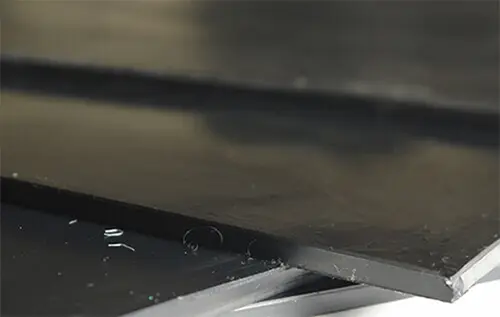
Hydrogenated nitrile rubber (HNBR) offers significant advantages over conventional NBR, positioning it as the premium choice for demanding applications:
These properties make hydrogenated nitrile rubber the ideal material for automotive applications, industrial applications, and severe service conditions where other elastomers, such as NBR, would fail.
Technical specifications of HNBR for high-temperature, oil, and severe condition applications
| PARAMETERS | METHOD | SPECIFICATIONS |
|---|---|---|
| SHORE A HARDNESS, Points | ASTM-D2240 | 70 - 75 |
| TENSILE STRENGTH, psi | ASTM-D412 | 2000 MINIMUM |
| ELONGATION, % | ASTM-D412 | 225 MINIMUM |
| TEAR RESISTANCE, Lb/Inch | ASTM-D624 | 50 MINIMUM |
| PARAMETERS | METHOD | SPECIFICATIONS |
|---|---|---|
| COMPRESSION SET (%), @100°C, 24 hours | ASTM-D395 | 20 MAXIMUM |
| CHANGE IN TENSILE (%), @100°C, 70 hours | ASTM-D471 | 15 MAXIMUM |
| CHANGE IN ELONGATION (%), @100°C, 70 hours | ASTM-D471 | 17 MAXIMUM |
| CHANGE IN VOLUME (%), @100°C, 70 hours | ASTM-D471 | 5 MAXIMUM |
| OPERATING TEMPERATURE, °C | ASTM-D471 | -60 TO +160 |
| SUBSTANCES | METHOD | SPECIFICATIONS |
|---|---|---|
| GREASES, OILS & HYDROCARBONS | ASTM-D471 | EXCELLENT |
| OZONE, UV LIGHT & WEATHERING | ASTM-D1171 | VERY GOOD |
| CONCENTRATED ACIDS & ALKALIS | ASTM-D471 | GOOD |
HNBR is ideal for seals, gaskets, O-rings, and components in automotive applications (under-hood), heavy machinery (hydraulic systems), oil & gas (downhole tools), and aerospace. Its extreme temperature resistance (-60°C to +160°C) and low compression set (20% maximum) ensure reliable sealing and long service life in the most demanding applications.
Discover the sectors where HNBR is the preferred choice for its extreme temperature and oil resistance
Hydrogenated nitrile rubber (HNBR) is ideal for engine seals, gaskets, oil hoses, and under-hood components exposed to high temperatures and oils. Its thermal resistance of -60°C to +160°C ensures durability in demanding automotive applications.
HNBR is the preferred choice for hydraulic seals, gaskets, and components in construction equipment and mining operating in severe conditions. Its high mechanical strength (2,000 psi) and abrasion resistance ensure reliable performance.
Hydrogenated nitrile rubber is used in drilling equipment, seals for downhole tools, and offshore applications. Its oil resistance and hydrocarbon resistance, combined with thermal stability, makes it indispensable in the petroleum industry.
Hydrogenated nitrile rubber (HNBR) is also used in aerospace for hydraulic system seals, in the chemical industry for chemical-resistant gaskets, in refrigeration systems for compressor seals, and in military applications for high-reliability components. Its versatility, extreme temperature resistance, and superior performance over NBR make it the preferred material for applications where reliability and durability are priorities.
Advantages that make HNBR the best choice for high-temperature, oil, and severe condition applications
Hydrogenated nitrile rubber operates continuously from -60°C to +160°C, far surpassing conventional NBR. Ideal for automotive applications and oil & gas where temperatures are extreme.
HNBR maintains its properties in contact with greases, oils, and hydrocarbons at high temperatures, ensuring reliable sealing in gaskets and O-rings.
With 2,000 psi tensile strength and 50 Lb/Inch tear resistance, hydrogenated nitrile withstands demanding loads in heavy machinery and drilling equipment.
Hydrogenated nitrile rubber offers superior performance against ozone, UV light, and weathering, extending service life in outdoor applications and aggressive environments.
Only 20% maximum compression set, ideal for sealing applications requiring shape retention and long service life.
HNBR offers good performance with concentrated acids and alkalis, making it suitable for the chemical industry and demanding industrial processes.
Hydrogenated nitrile rubber (HNBR) from Everest Group combines extreme temperature resistance (-60°C to +160°C), excellent oil resistance, and low compression set to deliver exceptional performance in automotive applications, heavy machinery, and oil & gas. ASTM certified, it guarantees safety, durability, and reliability in the most demanding applications, surpassing NBR in severe conditions.
Performance comparison in high-temperature, oil, and severe condition applications
Ideal for: High-temperature, severe condition, and dynamic sealing applications.
Ideal for: General applications with oils and moderate temperatures.
Ideal for: Extreme temperature and aggressive chemical applications.
Why choose HNBR? If your application requires extreme temperature resistance (-60°C to +160°C), excellent oil resistance, and low compression set in severe conditions, hydrogenated nitrile rubber (HNBR) is the best choice. It surpasses NBR in thermal resistance and FKM in low-temperature flexibility and cost, offering an exceptional balance for automotive applications, heavy machinery, and oil & gas. At Everest Group, we advise you to choose the right material for your project. Contact us.
Detailed analysis of properties, performance, and applications to help you choose the right material
HNBR (Hydrogenated Nitrile) is the evolution of NBR (Nitrile) with superior thermal resistance, chemical resistance, and lower compression set
| Property | HNBR (Hydrogenated Nitrile) | NBR (Nitrile) |
|---|---|---|
| Typical Operating Temperature Range | -60°C to +160°C | -40°C to +100/120°C |
| Oil & Fuel Resistance | Excellent (better than NBR, especially with aromatic hydrocarbons) | Very good (standard for oils and fuels) |
| Thermal / Aging Resistance | Very good — excellent property retention against heat and ozone | Fair — degrades faster with heat and ozone |
| Compression Set Resistance | Better (lower permanent deformation) | Good but inferior to HNBR |
| Chemical Resistance (acids, bases, solvents) | Good against many chemicals; sensitive to ketones and some esters/chlorinated | Good against hydrocarbons; variable with other solvents (check compatibility) |
| Abrasion & Wear Resistance | Good — superior in dynamic applications | Good, but generally lower than HNBR |
| Mechanical Properties (tensile, elongation) | High strength and good elasticity depending on formulation | Good mechanical properties; more economical |
| Dimensional Stability | Better in severe conditions (heat, oil) | Less stable against thermal aging |
| Service Life | Longer in aggressive and high-temperature environments | Shorter in severe conditions |
| Processability (molding, extrusion) | Good; may require peroxide curing for best properties | Very good; sulfur curing common (more economical) |
| Curing | Peroxide or sulfur; peroxide improves thermal resistance | Sulfur curing (common) |
| Relative Cost | Higher | Lower (more economical) |
| Typical Recommended Applications | Engine seals, compressor seals, downhole tools, gaskets in high-temp/oil systems | Gaskets, O-rings, hoses, and parts with moderate thermal/chemical exposure |
| Compatibility with Modern Fuels | Generally good; evaluate case by case (biofuels, ethanol) | Variable; some biofuels affect performance — verify compatibility |
|
Choose HNBR when higher heat, aging, and compression set resistance is required; justify by higher cost. Choose NBR for standard applications with good oil resistance and lower cost. |
||
At Everest Group, we have the solution you are looking for. From HNBR in rolls and sheets to custom seals, gaskets, and O-rings. Resistance from -60°C to +160°C, excellent oil and ozone resistance. ASTM certified. Get a quote in 24 hrs!
Do you have questions about hydrogenated nitrile rubber (HNBR)? At Everest Group, we have compiled the most common questions and their answers for you. Just select a question and you will see the answer immediately.
Hydrogenated nitrile rubber (HNBR) is a high-performance elastomer obtained by hydrogenating conventional nitrile (NBR). This process reduces double bonds in the molecular chain, giving it superior properties: high-temperature resistance (-60°C to +160°C), excellent oil and grease resistance, low compression set, and greater ozone resistance than NBR. It is ideal for demanding applications in automotive, heavy machinery, and oil & gas.
The main difference between HNBR and NBR is their thermal resistance and durability:
HNBR is the evolution of NBR for applications requiring greater reliability and extreme temperature resistance.
Hydrogenated nitrile rubber (HNBR) is used in applications requiring high temperature, oil, and severe condition resistance:
Hydrogenated nitrile rubber (HNBR) is available in rolls and sheets in different thicknesses and sizes to suit each project's needs. We also offer custom cutting and custom seal, gasket, and O-ring fabrication in HNBR. To learn about available options and receive a personalized quote, we invite you to contact us.
The choice between HNBR and FKM (Viton®) depends on the application:
At Everest Group, we advise you to choose the optimal material for your application.
Yes. Everest Group ships hydrogenated nitrile rubber (HNBR) in rolls and sheets throughout the United States, Canada, Mexico, Central America, and Spain. Delivery time depends on location and product availability. Contact us for shipping times and costs to your location.
Nitrile rubber with excellent oil and fuel resistance for industrial gaskets.
Explore RubberTransformer-grade nitrile for gaskets in transformers and oil-submerged electrical equipment.
Explore RubberDielectric rubber with 10kV/mm for high-voltage insulation and substations.
Explore Rubber