Dielectric Rubber
Dielectric rubber with 10kV/mm for high-voltage insulation and substations.
Explore RubberThe antistatic rubber you need for mats, floors, and workstations in electronics and laboratories. Controlled conductivity of 5,000 to 10,000 ohms. 70-75 Shore A hardness. Get a quote in 24 hrs!
Looking for a material that protects your electronic components from electrostatic discharge? Antistatic rubber is the solution you need. This specialized elastomer is formulated to control and dissipate electrostatic charges, protecting sensitive electronic components and preventing discharges in critical areas such as laboratories, clean rooms, and manufacturing lines.
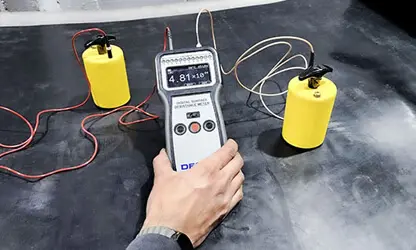
With a controlled conductivity range of 5,000 to 10,000 ohms (ASTM D991), antistatic rubber provides ideal protection against electrostatic discharge (ESD). Its 70-75 Shore A hardness and 1,750 psi tensile strength guarantee durability in demanding applications. It is the preferred material for antistatic mats, data center floors, workstations, and components in the electronics industry.
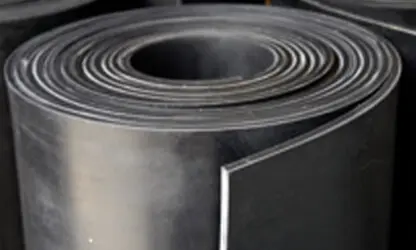
Available in rolls and sheets of antistatic rubber with ASTM certification. Need ESD control for your project? Keep reading to discover all the advantages of our antistatic rubber for electronics.

Antistatic rubber stands out for its static dissipation properties and excellent mechanical characteristics, ideal for ESD control in electronics and laboratories:
These properties make antistatic rubber an indispensable material in electronics manufacturing areas, laboratories, clean rooms, and any environment where static control is critical.
Technical specifications of antistatic rubber with 5,000-10,000 ohms conductivity for ESD control applications
| PARAMETERS | METHOD | SPECIFICATIONS |
|---|---|---|
| SHORE A HARDNESS | ASTM-D2240 | 70 - 75 |
| TENSILE STRENGTH, psi | ASTM-D412 | 1750 MINIMUM |
| ELONGATION, % | ASTM-D412 | 275 MINIMUM |
| TEAR RESISTANCE, KN/m | ASTM-D624 | 35 MINIMUM |
| TEMPERATURE RANGE, °C | ASTM-D573 | -20 TO 90 |
| CONDUCTIVITY RANGE, OHMS | ASTM-D991 | 5,000 TO 10,000 |
| ACOUSTIC INSULATION | - | HIGH |
| VIBRATION ABSORPTION | - | EXCELLENT |
| IMPACT ABSORPTION | - | HIGH |
| SUBSTANCES | METHOD | SPECIFICATIONS |
|---|---|---|
| CHEMICAL RESISTANCE | ASTM-D471 | GOOD |
| ACID AND ALKALI RESISTANCE | ASTM-D471 | GOOD |
| ALCOHOL RESISTANCE | ASTM-D471 | VERY GOOD |
Antistatic rubber with 5,000-10,000 ohms conductivity is ideal for antistatic mats, data center floors, workstations, and electronics components. Complies with ASTM standards for ESD control.
Discover the sectors where antistatic rubber is essential for protecting electronic components and preventing electrostatic discharge
Antistatic rubber is ideal for antistatic mats and work surfaces in sensitive electronic component assembly. Its controlled conductivity of 5,000-10,000 ohms protects against electrostatic discharge (ESD) in production lines and repair areas.
Antistatic rubber is the preferred choice for floors and workstations in research laboratories, development, and quality control. Its chemical resistance and easy cleaning make it ideal for environments where safety and precision are critical.
Antistatic rubber is used in components and coatings on electronics production lines, as well as data center floors and server rooms. Its durability and ESD control ensure protection of sensitive equipment.
Antistatic rubber is also used in the automotive industry for electronic component protection, in hospitals for operating room floors, in clean rooms for particle control, and in distribution centers for sensitive equipment protection. Its versatility and ESD properties make it the preferred material for applications where electrostatic protection and durability are priorities.
Advantages that make antistatic rubber the best choice for ESD control in electronics and laboratories
Antistatic rubber offers controlled conductivity of 5,000 to 10,000 ohms, ensuring safe dissipation of electrostatic charges in ESD areas, laboratories, and manufacturing lines.
Operates efficiently from -20°C to 90°C, maintaining its antistatic properties and mechanical performance in varying conditions, ideal for data centers and industrial environments.
With 1,750 psi tensile strength and 35 kN/m tear resistance, antistatic rubber withstands demanding conditions in mats, floors, and industrial components.
Antistatic rubber offers superior resistance to alcohols and good resistance to acids and alkalis, ideal for laboratories and manufacturing environments with chemical exposure.
High acoustic insulation factor and excellent vibration absorption, reducing noise in server rooms, laboratories, and manufacturing areas.
Excellent impact absorption and elastic properties, protecting equipment and components in work areas and production lines.
Antistatic rubber from Everest Group combines controlled conductivity of 5,000-10,000 ohms, superior mechanical resistance, and thermal stability to deliver exceptional performance in antistatic mats, data center floors, workstations, and electronics components. ASTM certified, it guarantees safety, durability, and reliability in the most demanding applications.
Materials certified under international standards for ESD control and electronic protection
Shore A Hardness
Certifies antistatic rubber hardness at 70-75 Shore A, ensuring strength and flexibility.
Mechanical Properties
Certifies 1,750 psi tensile strength and 275% elongation.
Tear Resistance
Certifies 35 kN/m tear resistance, guaranteeing durability.
Electrical Conductivity
Certifies controlled conductivity of 5,000 to 10,000 ohms for ESD control.
Need a certified material for ESD control? Our ASTM antistatic rubber guarantees maximum protection and reliability in ESD control applications. Contact us for technical support.
At Everest Group, we have the solution you are looking for. From antistatic rubber in rolls and sheets to custom antistatic mats for electronics, laboratories, and data centers. ASTM certified for ESD control. Get a quote in 24 hrs!
Do you have questions about antistatic rubber? At Everest Group, we have compiled the most common questions and their answers for you. Just select a question and you will see the answer immediately.
Antistatic rubber is a specialized elastomeric material formulated to control and dissipate electrostatic charges. It is primarily used to protect sensitive electronic components from electrostatic discharge (ESD) in laboratories, manufacturing lines, data centers, and work areas. Its controlled conductivity of 5,000 to 10,000 ohms ensures safe static dissipation.
Everest Group's antistatic rubber has a controlled conductivity range of 5,000 to 10,000 ohms (ASTM D991). This range is ideal for ESD control, allowing safe dissipation of electrostatic charges without being fully conductive, protecting sensitive electronic components in work areas and manufacturing lines.
Antistatic rubber is available in rolls and sheets in different thicknesses and sizes to suit each project's needs. We also offer custom cutting and custom antistatic mat fabrication for electronics, laboratories, and data centers. To learn about available options and receive a personalized quote, we invite you to contact us.
Yes. Antistatic rubber offers excellent resistance to alcohols and good resistance to acids and alkalis, according to ASTM D471. This makes it ideal for laboratories, manufacturing environments, and work areas where there is exposure to chemicals without losing its antistatic properties.
Yes. Everest Group's antistatic rubber complies with ASTM D2240 (Shore A Hardness), ASTM D412 (Mechanical Properties), ASTM D624 (Tear Resistance), and ASTM D991 (Electrical Conductivity). These certifications guarantee the quality, reliability, and safety of the material in ESD control applications.
Yes. Everest Group ships antistatic rubber in rolls and sheets throughout the United States, Canada, Mexico, Central America, and Spain. Delivery time depends on location and product availability. Contact us for shipping times and costs to your location.
Dielectric rubber with 10kV/mm for high-voltage insulation and substations.
Explore RubberConductive rubber for grounding, EMI/RFI shielding, and electrical charge dissipation.
Explore RubberDielectric EPDM with excellent insulation properties and weather resistance.
Explore Rubber